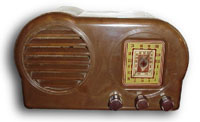
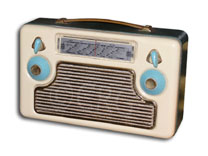
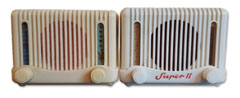
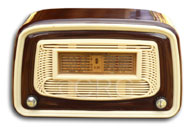
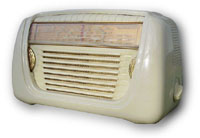
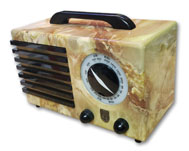
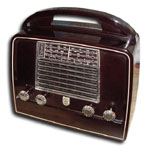
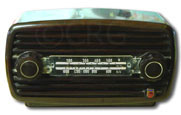
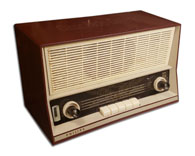
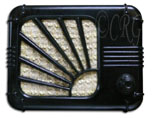
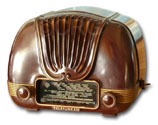
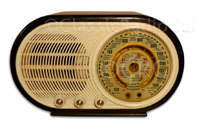
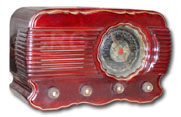
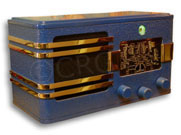
Made by Genalex in 1948. Genalex began in 1939 and made electronic equipment up until 1958.
It was typical of many vintage Argentine radios to have no
manufacturer markings other than the bakelite cabinet and the chassis stamped "Fabrica de Argentina".
Although only half the size, a very similar design to the US-made Belmonts
and the Aussie Technico Aristocrat.
The cabinet is made of chocolate brown bakelite.
During '40s and '50s, Genalex was a primary radio
manufacturer,
although many companies in Argentina
manufactured radios; Philips, Zenith (assembly only), Dumont, Westinghouse, Radio Serra, Noblex,
Tonomac, Radio Victoria, Admiral, Genalex, Grundig - to name a few.
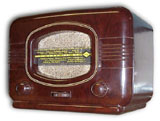
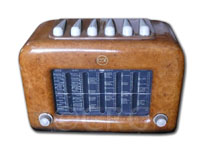
Eumig model 326, made in Austria, a small (9"w x 6.5"h)
2-piece brown-mottled bakelite radio.
The center
dial is reverse-painted glass and the escutcheon
is made from a separately molded bakelite piece.
Eumig was in production in Vienna from 1919-1985,
making movie cameras and projectors primarily, with radios and televisions also.
(Schematic 1,
Schematic 2)
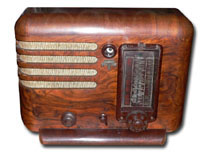
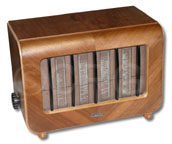
The Minerva model 376 was made in Austria. It is an impressive, large wood radio with fabulous wood grain patterns.
It was made in 1936/37 and featured a "magic eye" tuning indicator tube, and a unique tuning knob found on other Minerva models.
Minerva was founded as Radiola in 1924 by Wilhelm Wohleber in Vienna, using the names Radiola, RadioGlobe, Aeriola, Aerophon and Radiopa. To avoid
problems with large corporations using these names; Radiola by RCA in the USA and France, and Aeriola by Westinghouse, Wohleber
changed the name to Minerva in 1927. Minerva flourished all the way through the late 1960s. For more history on Minerva, try this
link.
(Schematic 1,
Schematic 2)
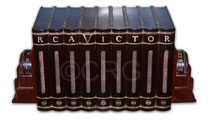
The model X-11 "Aladdin" ("Aladino") is a small 3-part bakelite construction, with the "bookends" sometimes found in white.
It measures only 4½ high and 9½ wide. (bottom label)
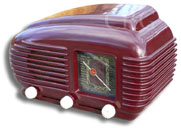
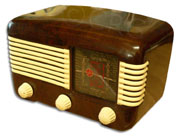
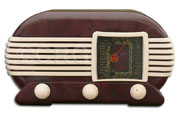
Tesla model 308u.
This is one of the world's most ubiquitous radios, due in part to 1 million that were made in a nearly 10 year run
in the 1950s.
Date stamps on chassis parts tells this example was built in mid-1959.
It's fabulous design would suggest it to be a mid-40s radio.
Another reason many survived is that the cabinet was very well made with very thick bakelite.
It was available in black, brown or burgundy.
The 4-tube, 3-band chassis was also high quality.
Schematic 1,
Schematic 2
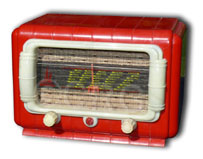
The BenGal "Sinai" has quickly become one of my favorites with it's bold cherry red plaskon cabinet,
trimmed with a translucent white surround that beautifully lights up on the sides of the dial and the red button below the dial.
It runs on 220 volts and I was told it was made in the UK for Israel,
although this French Telemonde
"Poucet" was discovered
that uses the same cabinet and dial surround, but with 3 knobs and a different dial configuration and rear cover.
The reverse painted dial glass lists Middle East and European cities,
and the back of the radio
lists the specs in English and Hebrew.
Schematic
RadioMarelli Model RD150. An interesting design with
inset volume and tuning control knobs,
made of white plaskon, in Italy, probably in the early 1950s.
(Close-up of embossed logo and model number on the back)
Schematic
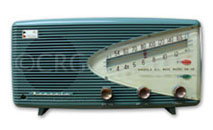
The rare Nanaola model 5M-55 "Piccolo" was one of the last tube radios and featured both AM and Shortwave bands.
The wild design immediately caught my eye with the Jetson's styled cabinet and slanted dial.
As transistors took over the US tube market in the late '50s, Japan continued making tube radios into the early '60s.
Made for the Japanese market, it operates on 100vac, and was easily adapted to US 120vac,
by substituting out the 30A5 output tube with a 50 volt tube to drop the additional 20v.
Schematic
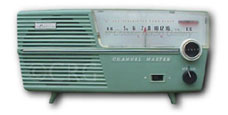
In the early '60s, Japan also made transistor radios.
The 6 transistor Channel Master model 6511 has "Jetson" style cabinet similarities to the Nanaola tube radio above.
These were imported into the US and are fairly common. It is a battery set, using 4 D-cell batteries.
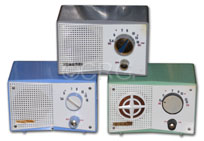
These tiny 1960s tube radios came in many colors with many grille and knob variations.
They were made for the US market with dozens of different names on them.
Russian speaker "radios". These were not actually radios, as they could not be tuned, but were plugged into wired Russian
government broadcasts.
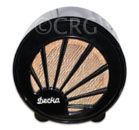
Both black bakelite cabinets have great sunrise designs. The round one is very small, measuring just under 6 in (15cm).
Most Russian speaker models were intended to hang on the wall.
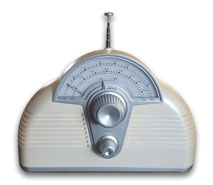
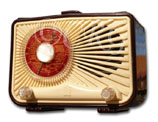
A fabulous midget radio, only 6½ inches wide, with an incredible starburst design radiating from a reddish-orange reflective dial.
The white plaskon facade is surrounded by a dark bakelite cabinet. The unique knobs have pearlescent caps.
Vilor typ 800G
VILOR was an electronics company from a little town called Follos, near Valencia.
The Vilor name is derived from Vicente López Rosat, the company's founder. The factory no longer exists.

 Austria,
 Chile,
 Czechoslovakia,
 Hungary,
 Israel,
 Italy,
 Japan,
 Latvia,
 Netherlands,
 Russia,
 Spain,
 Switzerland.
 Australia,
 Britain,
 Canada,
 France,
 Germany,
 USA (Classic Radio Gallery home page)